

Why Explainable, Integrated AI Is the Future of Insurance Underwriting
February 18, 2026
The Gradient AI Team
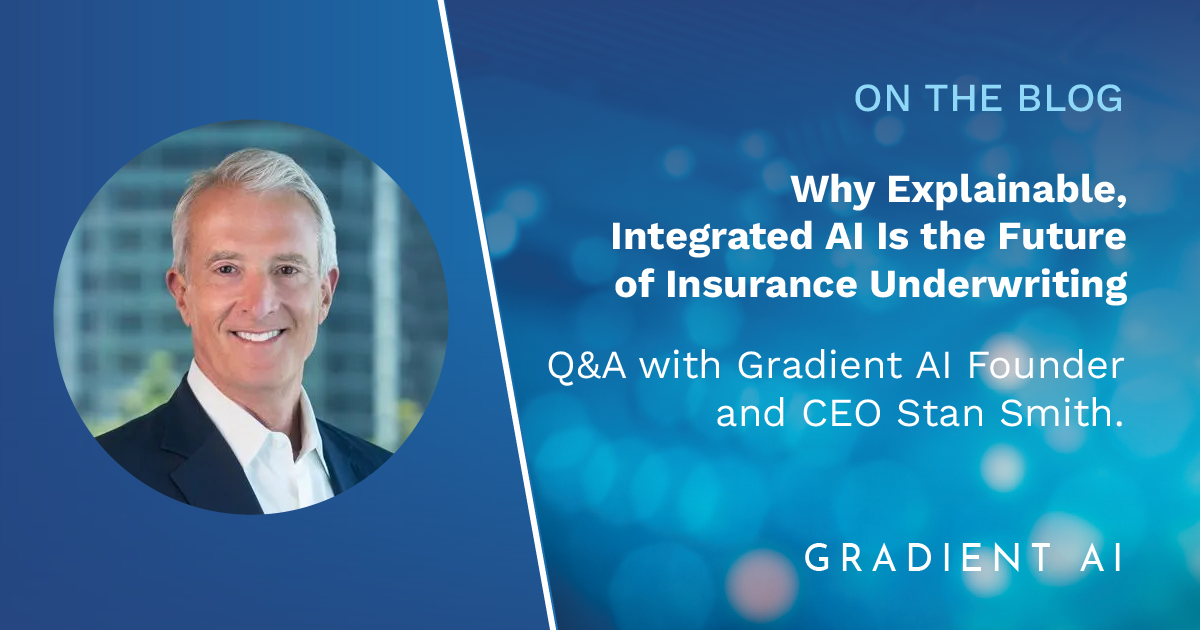
Q&A with Gradient AI Founder and CEO Stan Smith.
Q: What are your thoughts on the current insurance underwriting landscape overall? What’s happening right now?
Stan Smith:
Overall, insurers are becoming more comfortable using advanced analytics in underwriting and relying on a broader range of third-party data. Rather than depending solely on their own historical experience and narrow internal datasets, carriers are increasingly adopting more sophisticated tools because they’re seeing better results. Ultimately, outcomes are driving openness to newer techniques, and that’s the most important trend.
Q: As AI-driven underwriting solutions rapidly evolve, insurers have very different levels of AI maturity. How important is it to meet underwriters where they are, especially when their exposure to AI is still fairly basic?
Stan Smith:
Explainability is the fundamental issue. Insurers have historically relied on traditional methods not only because they understand them, but because regulators do as well. More advanced approaches raise concerns about complexity, specifically whether the methodology, lack of bias, and decision logic can be clearly explained to regulators. That concern has slowed adoption in many cases.
Q: What factors have most constrained broader adoption of AI-driven underwriting solutions?
Stan Smith:
The biggest constraint has been the belief that AI cannot deliver sufficient explainability. As a result, some organizations choose simpler, more transparent approaches, even when they’re less accurate. There’s been a clear divide: traditional methods prioritize explainability, while AI prioritizes accuracy. The real breakthrough comes when AI can deliver both. AI with explainability ultimately wins because it provides the most accurate pricing while still meeting regulatory and governance requirements.
Q: Many underwriters’ early experiences with AI involved first-generation solutions. How does Gradient AI address the concerns that came from those early limitations?
Stan Smith:
We leverage newer large language model techniques to help explain what advanced AI models are clearly identifying and in ways that are useful to underwriters. Earlier approaches often fell short in helping users truly understand the “why” behind a recommendation. Today, we can provide not just a decision, but the reasoning behind it in plain language.
For example, in healthcare underwriting, our platform can now deliver the kind of analysis that previously required a nurse review. Underwriters receive actionable insights and explanations directly from the AI, which significantly improves efficiency and confidence in the decision-making process.
Q: Would you also say that Gradient AI overcomes adoption roadblocks by acting as a true partner to its clients?
Stan Smith:
Absolutely. We work closely with our clients as partners, not just as a technology vendor. That means proactively addressing concerns around legal requirements, technology integration, utilization, and outcomes. A major focus is ensuring we can measure, demonstrate, and validate the absence of bias in the data and models we provide.
Because Gradient AI works with data across multiple carriers and geographies, we’re uniquely positioned to assess bias at a broader level. We can identify potential issues, prove when bias is not present, and help eliminate it where necessary. That capability is critical for building trust and long-term adoption.
Q: What are some key signals or patterns that AI-enabled underwriting solutions detect that humans might miss?
Stan Smith:
A strong example is small commercial policies in the P&C market, typically policies under $20,000 in premium. More than 98% of these policies never experience a loss. The challenge for underwriters is identifying which small subset is most likely to generate future claims.
AI excels here by analyzing the characteristics of policies that have experienced losses and identifying subtle combinations of factors that humans would struggle to detect. While AI won’t predict every individual loss, it can identify the group of policies most likely to account for the majority of claims. This has proven to be an extremely effective use case for AI in small commercial underwriting.
Another example is healthcare underwriting for small groups. Traditionally, carriers preferred large groups because risk naturally balances out. In small groups, however, a single high-cost individual can make the group unprofitable. Traditional methods often failed to detect that risk, which is why Gradient AI has been particularly successful in the small-group healthcare market since launch.
Q: As AI solutions become more sophisticated, how do you ensure they remain user-friendly?
Stan Smith:
It comes down to actionable intelligence. Underwriters need to quickly understand how the information helps them make decisions – daily, weekly, or long-term. The solution must clearly highlight areas of concern, allow users to drill down into key drivers, and show them what actions they can take to improve outcomes.
Q: How does more accurate underwriting benefit consumers and the insured, not just insurers?
Stan Smith:
Accuracy builds trust. When consumers distrust insurers, it’s often because they believe risk isn’t being assessed fairly. Gradient AI has no incentive to over- or underprice risk since we’re not the carrier. Our goal is to provide an unbiased, accurate representation of risk and expected cost so carriers can price appropriately and sustainably.
When the same organization both assesses risk and profits directly from pricing decisions, perceived bias can exist. Our independence helps eliminate that concern, which ultimately benefits consumers through fairer pricing and more stable coverage.
Q: Gradient AI differentiates itself through the integration of previously siloed AI solutions. How far ahead is the company in this area?
Stan Smith:
The insurance industry remains highly siloed, with many endpoint solutions and fragmented datasets. This makes it difficult for insurers to gain a holistic understanding of their business, such as identifying duplicate exposures or evaluating risk across multiple lines.
A core part of our strategy is connecting these silos to provide a unified view of a carrier’s book of business. That holistic perspective allows insurers to operate more strategically and make better decisions across their organization.
Q: How does an integrated risk management lifecycle improve enterprise-level performance?
Stan Smith:
AI becomes more powerful as it learns from a company’s own performance over time. By observing the full lifecycle of risk within a client’s portfolio, our models can identify which types of risks perform well and which do not.
Future underwriting, portfolio management, and strategic decisions are then informed by that specific carrier’s historical strengths and challenges, not generic industry averages. The system continuously learns, becoming more accurate and better aligned with the insurer’s capabilities over time.
Q: What’s the next game-changing milestone for AI-driven underwriting, and how is Gradient AI moving toward it?
Stan Smith:
The next major milestone is bringing together data that has never been meaningfully combined before. For example, insights from healthcare data informing property and casualty underwriting. Historically, data has remained locked within verticals, limiting its broader value.
Gradient AI is at the forefront of responsibly connecting these datasets to generate deeper insights for our customers and unlock new opportunities across insurance lines.
Stay on top of AI trends by subscribing to Advanced Insights, the newsletter for strategies, ideas, and insights on AI insurance, delivered to your monthly inbox. Subscribe Now →