

How can MGUs and stop-loss carriers see group health risk earlier?
AI underwriting tools like Gradient AI’s SAIL™ draw on more than 10 million health data points and 325 million U.S. medical records. They predict high-cost claimants and future claim severity before those costs reach the loss ratio. That lets carriers confidently write complex groups and apply consistent risk logic from quote through renewal.
In group health insurance, the risks that hurt most are usually the ones nobody saw coming. A high-cost claimant surfaces mid-year. A cluster of comorbidities hides behind incomplete data. A group that looked manageable at quote turns into a loss-ratio problem at renewal.
Meanwhile, the pressure keeps building. Healthcare costs are rising, risk patterns are shifting, and employer groups expect more value for less. Underwriting teams are asked to move faster and price more precisely, often with fragmented data and little time.
The carriers and MGUs pulling ahead are the ones that see the full picture of risk: the groups others pass on, the underwriting decision itself, and the entire policy life cycle that follows. Here is what that looks like in practice.
The underwriting risk your data won’t show you
The biggest exposures in group health rarely announce themselves in a census file. Three blind spots come up again and again:
- Comorbidities and prescription patterns that combine into hidden exposure no single data point reveals.
- Incomplete or outdated data that leaves underwriters filling gaps with assumptions.
- Sudden spikes in claim severity that catch stop-loss carriers off guard after the policy is bound.
Traditional rating methods weren’t built to connect these dots. That’s the gap Gradient AI’s SAIL™ is designed to close.
SAIL draws on more than 10 million health data points and over 325 million integrated U.S. medical records. With that foundation, it predicts high-cost claimants and future claim severity before they show up in your loss ratio, not after.
Just as important, SAIL makes complex risk clear and usable for everyone involved. Underwriters, actuaries, and leadership work from the same view of a group, so decisions are consistent and easier to defend. The result is underwriting your whole team can stand behind.
Case study: writing the business other MGUs turn down
Plenty of MGUs say they can handle complex, non-traditional groups. Evolution Risk Partners (ERP) built a reputation for actually doing it.
Over four years with SAIL, ERP turned difficult risk into a repeatable pipeline:
- Writing groups competitors pass on. Where other markets decline, ERP has the insight to price and accept.
- Onboarding business traditional methods couldn’t support. Groups that didn’t fit conventional underwriting models became workable.
- Becoming the go-to market for brokers. When brokers have nowhere else to turn, ERP is the call they make.

The outcome is a growing book of alternative risk that speaks for itself, and a partnership that has lasted four years and counting.
The lesson for other MGUs is simple. Complex groups aren’t inherently bad risk; they’re poorly understood risk. With the right data and models, they become a competitive advantage.
Beyond the quote: managing risk across the policy life cycle
A sharp underwriting decision is only the start. Risk keeps evolving after a policy is bound, and carriers that evaluate it one way at quote and another way at renewal leave value on the table.
The answer is consistency: applying the same AI-powered risk logic at every stage of the policy life cycle.
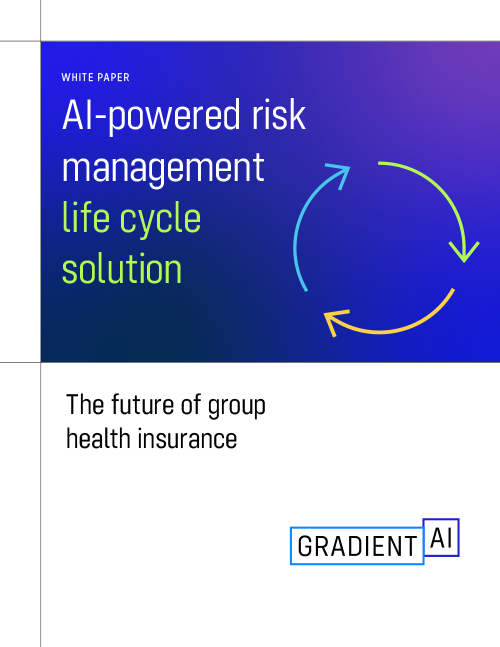
- New business quoting. Price groups accurately from day one, including those with limited or messy data.
- Renewal pricing. Update the view of each group as claims experience develops, so renewals reflect real risk rather than last year’s assumptions.
- Population health management. Identify emerging high-cost claimants early enough to act, not just to reserve.
When every team works from the same data-driven insights, carriers can move faster without sacrificing precision, even as costs rise and employer expectations grow.
See the full picture of risk
The groups others decline, the hidden exposures inside every census, and the shifts that happen between quote and renewal all have one thing in common: they’re easier to manage when you see them early.
AI-powered underwriting gives MGUs and stop-loss carriers that earlier view, and the confidence to act on it.
Want to learn how Gradient AI can help your team?
Contact our group health and enterprise health sales teams, and subscribe to our monthly newsletter for more insights on AI in health insurance.

